

With equity markets sitting near all-time highs, it’s natural for investors to feel uneasy. For clients who have recently entered the market, the concern is often, “What if a correction is around the corner?” For those who have been invested for longer, the temptation may be to “bank profits” and wait for a better entry point.
These reactions are understandable. But history shows that acting on them is often more harmful than helpful.
Most balanced portfolios have meaningful exposure to equities, both locally and offshore. That exposure is intentional. Equities are volatile in the short term, but they remain the primary driver of long-term growth. Peaks and troughs are simply part and parcel of the investor’s experience.
The problem with “just stepping aside”
Market timing sounds simple in theory. You sell when things feel expensive or risky, and buy back when conditions feel better.
In practice, it requires two decisions to be right:
- The day you exit, and
- The day you get back in.
Most investors focus on the first decision and underestimate the second. Yet as illustrated in the graph above, the re-entry decision is often the more damaging one to get wrong.
The market’s strongest days typically occur during periods of heightened volatility, often close to the worst days. This means the best and worst days frequently cluster together, sometimes within the same week, or even on consecutive days. Investors who step aside during uncomfortable periods often miss the very recoveries that drive long-term performance.
By the time things feel “safe” again, those critical days have often already passed.
Why Missing a Few Key Days Can Derail Long-Term Returns
Roughly 80% of long-term equity returns are earned on just 2% of trading days. If you are out of the market on those few critical days, the impact on long-term returns is severe.
One of the most important and often misunderstood features of equity markets is how returns are generated. They do not accrue smoothly or evenly over time. Instead, a very large portion of long-term returns occurs on a surprisingly small number of trading days.
This is best illustrated by the graph below, which shows how much your return can fall if you jump in and out of the market at inopportune times, inadvertently missing some of its best days.
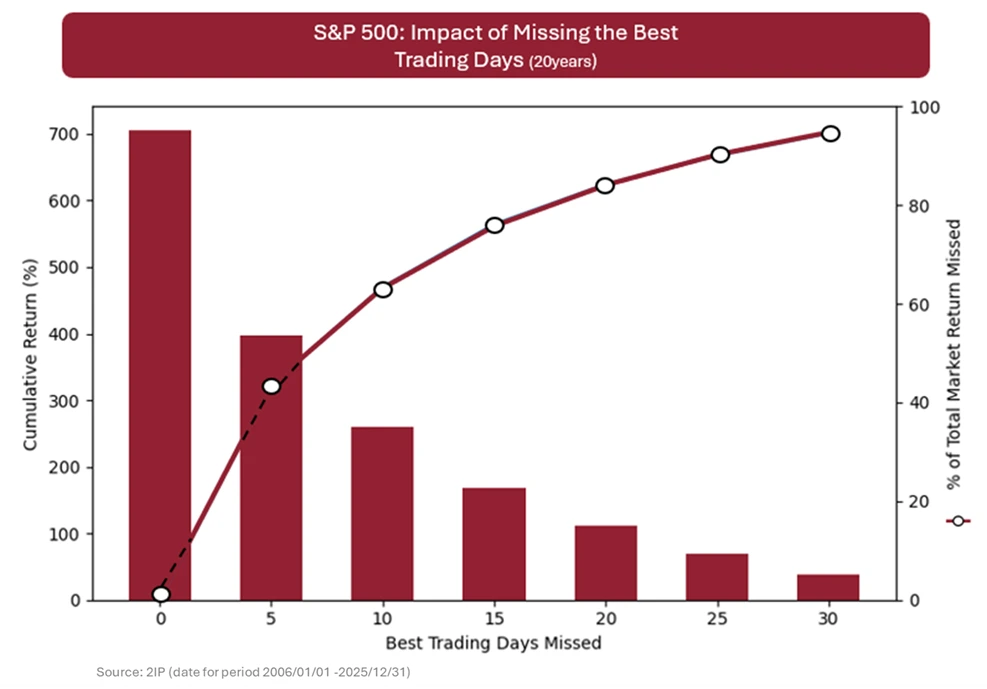
The horizontal axis represents the number of days missed, including some of the best days. The red bars show the returns that an investor would have achieved and are measured on the left axis, while the red line shows by how much an investor’s overall return would fall, and is plotted on the right vertical axis. For the 20 years to 31 December 2025, those who remained fully invested would have achieved a return of over 700%. If you missed the 10 best days, your return dropped by more than 60% and if you had missed the best 30 days, your return would have fallen by over 90% over the 20 years.
Volatility is not the real risk
It’s easy to think that volatility is the enemy. In reality, for a long-term investor, the greater risk is being out of the market at the wrong time.
Short-term market movements are noisy, bumpy and emotionally challenging. Watching portfolios daily, reacting to headlines, or constantly checking your investment statements can amplify anxiety and lead to poor decisions.
Portfolio values fluctuate every day, but those movements rarely require action. Repeatedly checking statements simply increases stress and raises the likelihood of reacting at exactly the wrong time. If it adds no value and only increases anxiety, why do it at all? Monitor values over the correct measurement period.
Successful investing is not about avoiding uncertainty. It’s about accepting that uncertainty is unavoidable and having a plan that lets you stay invested through it.
Trusting the Process
Our role is not to predict market tops or bottoms. It is to help clients build investment strategies aligned with their time horizon, objectives, and risk tolerance, and to support them through the inevitable ups and downs along the way.
Peaks and troughs are not signals to act; they are part of the journey. History consistently shows that time in the market matters far more than trying to time the market.
The investors who build lasting wealth are not those who react the fastest, but those who remain disciplined, patient, and committed to a sensible long-term strategy even when markets feel uncomfortable.
Disclaimer
The opinions expressed in this article are those of the author and do not necessarily reflect the views of Stone Wealth Management. The content is provided for general information purposes only and should not be construed as advice. Readers should seek appropriate professional advice before acting on any information or opinions expressed.