

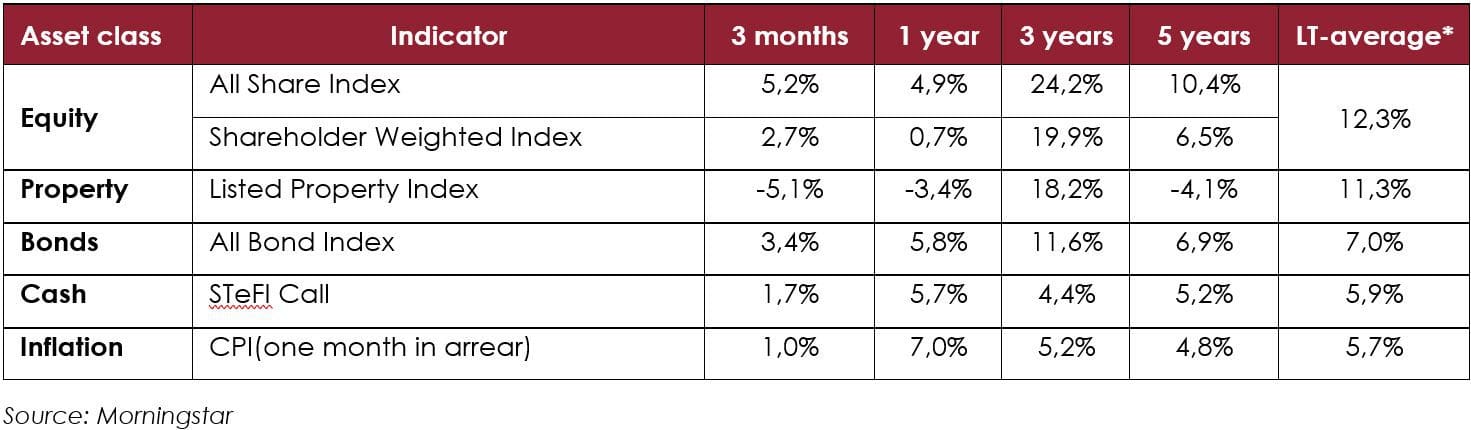
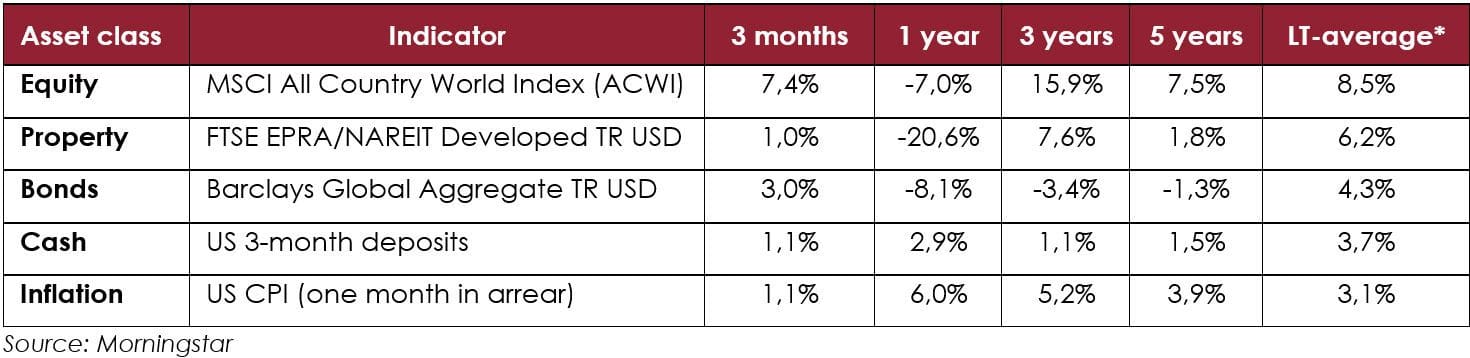
The table below provides a review of key domestic and international investment indicators for the past quarter, as well as over longer periods.
South African asset classes (in rands)
(Performance over periods to 31 March 2023)
Global asset classes (in dollars)
(Performance over periods to 31 March 2023)
Currencies
(Movements over periods to 31 March 2023)

* Updated annually from 1900, or longest available period
Returns for periods longer than 12 months are annualised
INTERNATIONAL MARKET COMMENTARY
The first quarter of 2023 proved to be no less eventful than 2022, although despite this, returns for the major asset classes were positive over the period. Market movements, like much of 2022, were mainly dominated by central bank action and rhetoric. The fact that central banks remained very dependent on incoming data (especially around inflation and employment) to determine policy direction only added to the uncertainty and volatility during the period.
January proved to be an excellent month for markets, with both global equity and bond markets rallying strongly during the month. Investor sentiment was supported by several factors the main being: declining inflation, ‘dovish’ (looser policy) central bank comments especially by the US Federal Reserve Chairman Powell, relatively mild weather in Europe (helping to push down energy prices), and China’s reopening after the government abandoned its zero-covid policy late last year. This resulted in markets rapidly discounting the best possible scenario of sharply falling inflation (back to central bank targets), falling interest rates, and a ‘soft-landing’ for economic growth.
A reversal of some of the strong gains experienced in January was seen in February, with both global equity and bond markets falling during the month. Somewhat paradoxically investor sentiment was negatively impacted by strong economic data releases (especially a bumper US jobs report), as markets reverted to the ‘good news’ is ‘bad news’ playbook. Essentially, good news for the economy (and in particular employment) implies more persistent inflation, which infers higher for longer central bank interest rates, which is broadly bad news for markets. We also saw higher than expected inflation indicators coming out of US and Europe and subsequent ‘hawkish’ (tighter policy) rhetoric from the Federal Reserve and ECB. If markets started to price in a ‘soft landing’ in January, they moved to expecting a ‘no landing’ (no slowdown) in February.
The end of the quarter witnessed heightened concerns regarding the banking sector in the US and Europe. In the US this was sparked by a classic ‘bank run’ on Silicon Valley Bank (SVB), the 16th largest US bank by assets, which specialised in providing banking services to a niche area of venture capital backed IT start-ups. Whilst US authorities were very quick to provide deposit guarantees and liquidity to calm the situation, it generated a significant amount of concern regarding the health of other regional banks, in fact banks in general. The jittery market meant that, in Europe, we saw a completely unrelated matter led to a hurriedly arranged takeover of ‘accident prone’ Credit Suisse by UBS. Fears over whether this was 2008 all over again unsurprisingly spread, but reassurances from authorities that banks had more capital and were better regulated, especially large systemically important banks, managed to assuage concerns.
How has this translated to financial markets?
Well despite the volatility it was a good quarter for returns (albeit largely driven by the very strong January), with global equities (+7,4%) rising sharply. The improved energy situation (lower gas prices) benefited Europe ex UK (+8,6%), whilst UK equities (+3,2%) lagged the most due to its relatively high exposure to financials and energy stocks. In terms of style, the interest rate sensitive growth stocks (+13,8%) outperformed the more value / cyclically (+1,4%) orientated equities by a significant margin. This was to some extent also reflected in sector performance, with Information Technology (+20,5%), Communication Services (+17,2%), and Consumer Discretionary (+14,2%), the best performing areas. At the other end of the spectrum Energy (-2,9%), Healthcare (-1,5%) and Financials (-1,3%) sectors trailed the most.
Within fixed income markets, declining inflation, and increased risk appetite (especially at the start of the year) meant all areas generated positive returns. Looking at the detail, global government bond prices rose (+3,0%), on reduced interest rate expectations. Global investment grade credit (+3,1%) generated a positive return over the month as spreads tightened, and at the risker end of the credit spectrum the same was true with global emerging market debt (+2,2%) and global high yield (+3,6%) also rallying strongly.
In terms of real assets, the more economic sensitive property markets underperformed equities over the period with the global REITs index up +1,0% over the period. Global listed infrastructure (+4,0%) also lagged equities, but to a lesser degree, demonstrating its more defensive qualities. Commodities (-5,4%) overall declined during the quarter, however, there was significant divergence across the different markets. Gold (+8,1%) was the brightest area in terms of returns, helped by a weaker US dollar and declining interest rate expectations. Whilst agricultural commodities were broadly flat, Industrial metals (-2,1%) and Crude Oil (-5,2%) declined, reflecting lower demand prospects due to slowing economic growth concerns towards the end of the period.
Local Market Commentary
Headline inflation for the year to December 2022 moderated further to 7,2%, while core inflation also eased. The Monetary Policy Committee (MPC) of the South African Reserve Bank (SARB) lifted the bank’s key lending rate by 25 bps (0,25%) to 7,25% in January. The assessment was that risks to the inflation outlook were seen to be to the upside. Meanwhile, energy availability and the consistency thereof, remained front of mind as the country faced consistent and worsening loadshedding. Energy regulator Nersa granted Eskom tariff increases of 18,65% for the 2023/24 year and 9,74% for 2024/25. Nonetheless, the domestic financial markets staged a recovery in the first month of the year, with the FTSE/JSE All Share gaining 8,9%. The FTSE/JSE All Bond Index gained 3,0% in January, while the rand depreciated by 2,3% against the US dollar.
The main event in February was the 2023 National Budget which confirmed a gross tax revenue overrun of R93.7bn relative to the 2022 Budget. This resulted in improved fiscal metrics for the financial year. Government announced a debt relief arrangement (with conditionality) for Eskom of R254bn, which will service the SOE’s debt burden over the next three years. The Financial Action Task Force (FATF) decided to classify South Africa as a jurisdiction under increased monitoring, adding it to the so-called grey list. While this was largely anticipated, grey listing is expected to increase compliance and transaction costs with the potential to hamper capital flows and impact the country’s appeal as an investment destination. The rand depreciated by approximately 5,5% against the US dollar and secured a spot amongst the worst performing currencies as at the end of February. The local bond market tracked the weaker rand, while the domestic equity market fell in line with global sentiment and shed over 2,0% over the month.
The final month of the quarter saw local headline inflation for the year to February 2023 increased to 7,0% from 6,9% in January, with core inflation increasing to 5,2%. Both figures were higher than market expectations, reflecting continued upward pressure in food prices, while annual medical aid tariff increases led to higher core inflation. The MPC of the SARB lifted the bank’s key lending rate by 50bps (0,50%) to 7,75%. Three members of the MPC voted in favour of a 50bps increase and 2 members voted in favour of 25bps. The SARB downgraded forecasts for economic growth further for 2023, given elevated levels of loadshedding with marginally higher figures over the medium term. Against this backdrop, the FTSE/JSE All Bond Index gained 1,3% in March and 3,4% over the quarter, despite being faced with a myriad of headwinds, including the country being grey listed and the turmoil surrounding the US and European banks. The rand appreciated by c.3,1% against the US dollar in March, supported by hawkish tones from the SARB and a weaker US dollar. Domestic equity markets declined over the month as the local energy crises weighed on domestically orientated mid and small cap counters. Global market volatility spilled over into local stock performance, with banks trading down 6,8% over the month while gold miners rallied.
DISCLAIMER
Nedgroup Collective Investments (RF) Proprietary Limited is an authorised Collective Investment Scheme and the representative of Nedgroup Investments Funds PLC in terms of the Collective Investment Schemes Control Act. It is a member of the Association of Savings & Investment South Africa (ASISA). Collective Investment Schemes are generally medium to long-term investments. The value of your investment may go down as well as up. Past performance is not necessarily a guide to future performance. Nedgroup Investments does not guarantee the performance of your investment and even if forecasts about the expected future performance are included you will carry the investment and market risk, which includes the possibility of losing capital. Our funds are traded at ruling prices and can engage in borrowing and scrip lending. Certain funds may be subject to currency fluctuations due to its international exposure. Nedgroup Investments has the right to close funds to new investors in order to manage it more efficiently. A fund of funds may only invest in other funds, and a feeder fund may only invest in another single fund, both will have funds that levy their own charges, which could result in a higher fee structure. A schedule of fees, charges and maximum commissions is available on request from Nedgroup Investments.
For any further information, please contact us on 031 832 4555 or via email on admin@stonewm.co.za