

Market Review
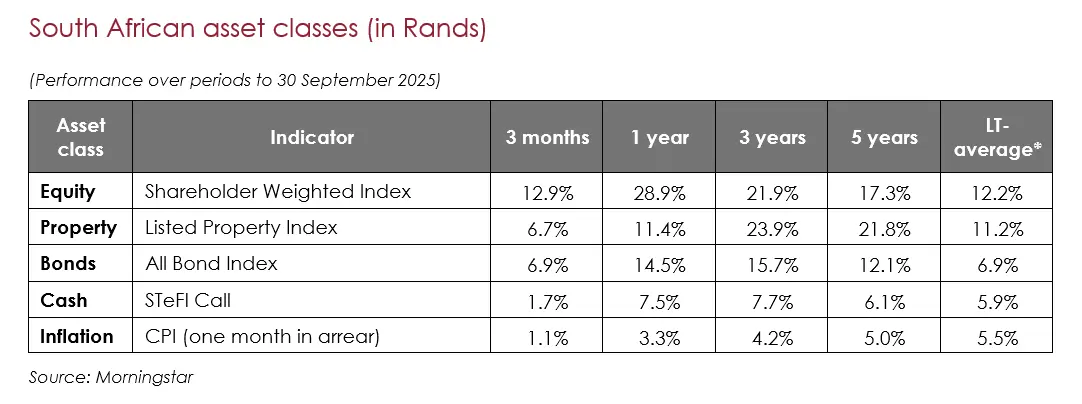
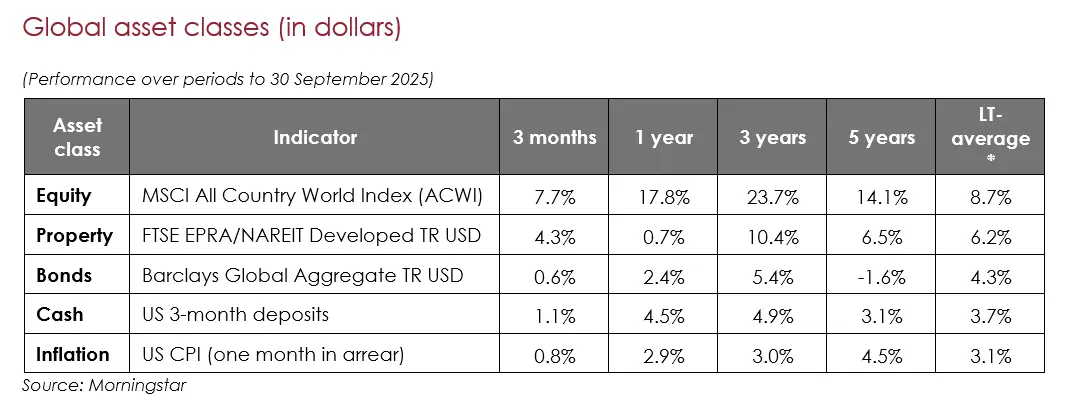
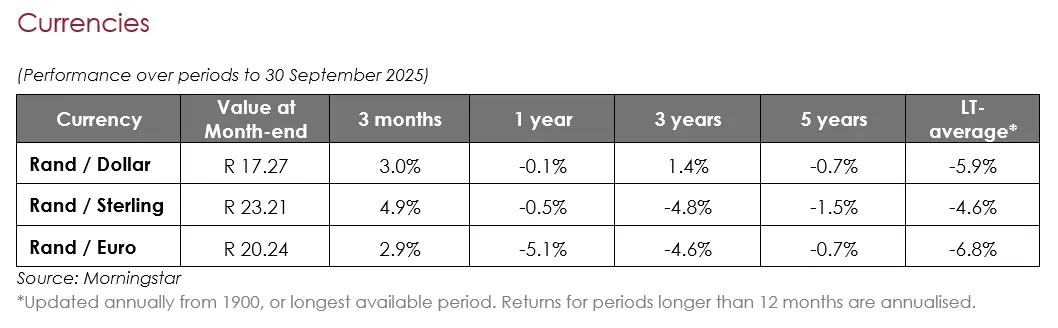
The table below provides a review of key domestic and international investment indicators for the past quarter, as well as over longer periods.
International Market Commentary
The third quarter of 2025 delivered broadly positive returns across global equities and bonds, defying lingering concerns around tariffs and fiscal instability. While the quarter began under the shadow of escalating trade tensions, a dovish pivot from the Federal Reserve helped drive risk assets higher.
Markets entered Q3 still digesting the implications of the sweeping tariff programme announced in April. The original 90-day extension deadline loomed large in early July but was ultimately pushed back to August 1. President Trump’s subsequent letters to trading partners outlined revised tariff rates, 15% for the EU and Japan, less severe than feared, but still above the 10% baseline. Canada saw its rate on non-USMCA goods rise to 35%, while sector-specific tariffs added further complexity: copper imports faced a 50% levy from August, and branded pharmaceuticals were hit with a 100% tariff effective October 1.
Labour market data in the US weakened notably over the quarter. July’s jobs report revealed significant downward revisions to prior months, totalling -258k, the largest since the pandemic-era recalibrations of May 2020. August payrolls disappointed further, rising just +22k, while unemployment ticked up to 4.3%, its highest since late 2021. In response, the Federal Reserve pivoted decisively. Chair Powell’s Jackson Hole remarks acknowledged growing labour market fragility, and the Fed delivered its first rate cut of the year in September, lowering the federal funds target range to 4.00–4.25%. Forward guidance signalled another 50bps of easing by year-end, providing a tailwind for risk assets as well as treasuries and gold.
Elsewhere, central banks were less active. The ECB held rates steady at 2%, and the Bank of Japan maintained its 0.5% policy rate while announcing plans to unwind ETF and J-REIT holdings. Geopolitical tensions briefly flared mid-August amid speculation of a Ukraine ceasefire following meetings between President Trump, President Putin, and European leaders. However, no agreement was reached, and markets largely shrugged off the headlines.
Finally, fiscal stability came into question over the quarter particularly in France. Prime Minister Bayrou’s loss of a confidence vote and Fitch’s downgrade of France’s sovereign rating from AA- to A+ put pressure on French yields, which had some spill over to Germany and the UK who saw similar moves. In the US, long-end Treasuries remained more stable however, political interference resurfaced, as President Trump dismissed Fed Governor Lisa Cook, raising concerns over Federal Reserve independence.
Given this backdrop, equities were well supported, with the global index up by +8.0%, with Asia Ex-Japan (+12.8%) and Emerging Markets (+12.2%) leading the way, whilst Europe ex-UK (+3.9%) lagged. In terms of equity styles, growth stocks (+9.0%) outperformed value (+6.3%), and small-cap stocks (+8.2%) were in line with large caps (+8.0%). There was wide variation in sector performance, with IT (+12.8%) and Communication Services (+11.9%) being the strongest two sectors, while Consumer Staples (-1.6%) and Real Estate (+2.0%) lagged significantly.
Fixed income markets were positive supported by high starting yields. Looking at the details, global government bonds (+0.7%) finished the quarter above water, but lagged Investment Grade Credit (+2.2%), Global High Yield (+2.4%) and global emerging market debt (+4.4%). Page 3
In the real assets space, global real estate (+4.4%) and global infrastructure (+2.7%) were well bid but lagged equity markets. Finally, Commodities (+3.6%) had a reasonable quarter with Gold (+16.4%) being a clear stand out, supported be geopolitical tensions and purchases from central banks.
Numbers reported in US dollars.
Local Market Commentary
The South African markets showed resilience as the third quarter kicked off, the FTSE/JSE All Share Index rose 2.3% in July, briefly crossing the 100,000-point mark for the first time. SA Listed Property led asset class returns with a 4.4% gain, followed by bonds at 2.7%. Economic indicators were broadly supportive: vehicle sales hit a post-2019 high, the Absa PMI climbed above 50, and headline inflation edged up to 3.0%, prompting the SARB to cut rates by 25bps to 7.0%. Political developments, including ministerial changes and the passage of the Appropriation Bill, helped ease coalition tensions. Progress on Operation Vulindlela reforms and the FATF’s recognition of anti-money laundering efforts further supported sentiment, despite the rand weakening 2.6% against the dollar in the month of July.
South Africa also made notable strides in rail and logistics reform. In August Transport Minister Barbara Creecy announced that eleven private operators have been granted conditional access to Transnet’s rail network—marking a historic shift toward private sector participation. The initial allocation spans 41 routes across six corridors, focusing on bulk commodities such as iron ore, coal, and chrome. Moody’s responded positively, upgrading Transnet’s national credit rating following new government guarantees announced in July. However, challenges remain: NERSA confirmed a settlement with Eskom over revenue miscalculations, resulting in a R54 billion shortfall to be recovered through higher electricity tariffs over time.
In the final quarter of the year, state power utility, Eskom, reported a profit before tax of R23.9 billion for the year ended 31 March 2025, a sharp turnaround from a R25.5 billion loss recorded the previous year. This marks Eskom’s first return to profitability since 2017. Meanwhile, the economy showed signs of recovery in Q2 2025, with real GDP increasing by 0,8%, up from 0.1% in Q1. Headline inflation for the year ending August 2025 eased to 3.3%, down from 3.5% in July. The SARB held interest rates at 10,5% in September, after cutting rates by cumulative 125 basis points over the past year.
Equities outperformed bonds during the quarter, gaining 12.9%, while bonds returned 6.9%. The yield on the 10-year government bond declined to 9.18%, supported by the proposed lower inflation target and South Africa’s proposed upweighting in the JPM Emerging Market Bond Index. Equity performance was driven by the resources sector, which gained 50.8%, supported by rising gold and platinum prices. The rand strengthened against major currencies, closing at R17.27 to the dollar, up 2.7% for the quarter amid dollar weakness. It also gained 4.8% against the pound and 3.2% against the euro over the same period.
Source: Various, including the Market Review by NPW Investment Research
DISCLAIMER
Nedgroup Collective Investments (RF) Proprietary Limited is an authorised Collective Investment Scheme and the representative of Nedgroup Investments Funds PLC in terms of the Collective Investment Schemes Control Act. It is a member of the Association of Savings &; Investment South Africa (ASISA). Collective Investment Schemes are generally medium to long-term investments. The value of your investment may go down as well as up. Past performance is not necessarily a guide to future performance. Nedgroup Investments does not guarantee the performance of your investment and even if forecasts about the expected future performance are included you will carry the investment and market risk, which includes the possibility of losing capital. Our funds are traded at ruling prices and can engage in borrowing and scrip lending. Certain funds may be subject to currency fluctuations due to its international exposure. Nedgroup Investments has the right to close funds to new investors in order to manage it more efficiently. A fund of funds may only invest in other funds, and a feeder fund may only invest in another single fund, both will have funds that levy their own charges, which could result in a higher fee structure. A schedule of fees, charges and maximum commissions is available on request from Nedgroup Investments.